
Learn how to confidently plan an automation before building it. This ManageMe guide walks you through identifying the right problem, mapping triggers and actions, and using a simple checklist. Ideal for non-technical business owners who want smoother systems without the overwhelm.
Why Planning Comes First #
Before building any automation, it pays to slow down and plan.
When automations are rushed or built without clarity, they often create more confusion instead of saving time. Planning first ensures the automation actually supports how your business runs.
A clear plan helps you:
- Save time and avoid rework
- Build something that solves a real problem
- Feel confident when it comes time to set it up
Automation works best when it starts with purpose, not just a tool or template.
This guide walks you through a simple, non-technical way to plan an automation before anything is built.
Step 1: Identify the Problem You Want to Fix #
Start with one simple question:
What do I do repeatedly that I wish happened automatically?
Common examples we see include:
- Forgetting to follow up with new leads
- Spending too much time sending reminder emails
- Wanting every new client to receive the same welcome message
- Having no clear system for tracking form submissions
Commonly, the first problem to solve is knowing when to use email automation vs. manual emails to keep your communication feeling human.
Choose one clear problem to start with. Automation should reduce friction, not add complexity.
Step 2: Understand the Three Core Pieces #
Every automation, no matter how simple, has three parts.
Input #
This is what starts the automation.
You might also hear this called a trigger.
Ask yourself: What needs to happen to start this process?
Examples include:
- A form is submitted
- A lead is added to your system
- A booking is made
- A specific date arrives
Action #
This is what the system does automatically.
Ask yourself: What task do I want handled for me?
Examples include:
- Sending an email or text
- Notifying you or your team
- Adding a tag or note
- Creating a task or reminder
Outcome #
This is the result you are aiming for.
Ask yourself: What does success look like once this automation runs?
Examples include:
- Every lead receives a quick response
- Fewer missed appointments
- Better internal visibility
- Less manual admin
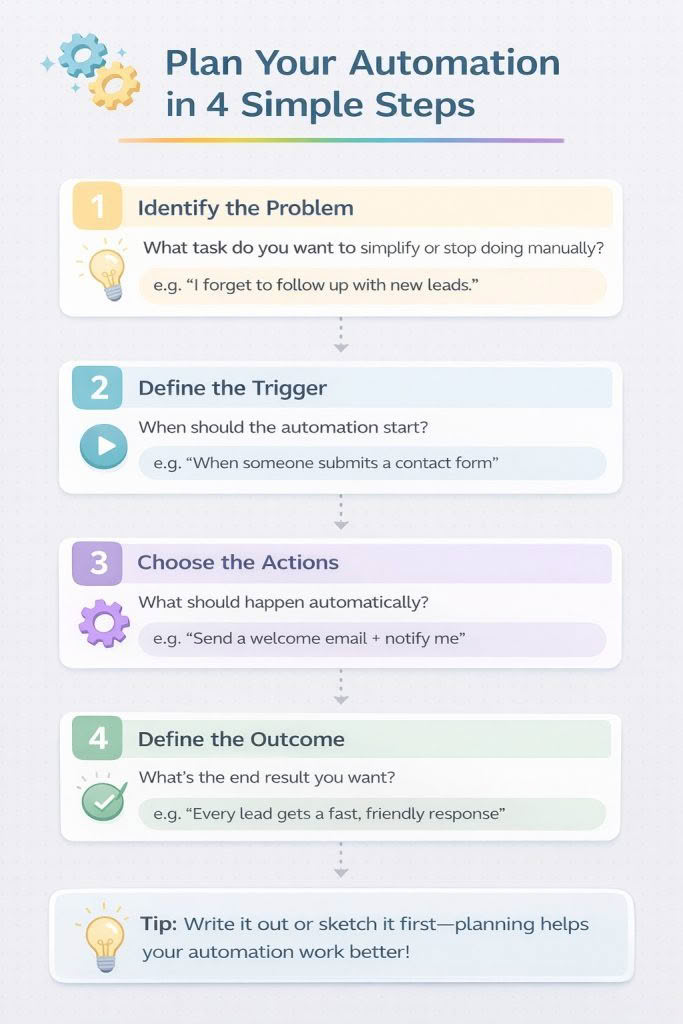
This simple framework helps plan automations before anything is built. Identify the problem first, then define the trigger, actions, and outcome.
Step 3: Use a Simple Planning Checklist #
Before building anything, write your automation out using a short checklist.
Automation Planning Checklist #
- What problem am I trying to solve?
- What event should start the automation?
- What should happen automatically?
- What is the final outcome I want?
- Are there any conditions that should apply?
- Who needs to be notified or included?
This step alone prevents most automation mistakes.
Example: Planning a Lead Follow Up Automation #
Here is what a completed plan might look like.
- Problem
New leads are not followed up quickly - Input
Someone submits the contact form - Action
Send a welcome email and notify the owner - Outcome
Every lead feels acknowledged straight away - Condition
Only send if the lead has not been contacted before - Who is involved
Business owner
Once this is clear, the automation itself becomes simple to build.
Practical Tips Before You Build #
- Start small with one automation
- Focus on real problems, not features
- Write the steps out first
- Test before going live
Good automation should feel invisible when it works.
You Are Ready to Plan With Confidence #
You do not need technical skills to plan automation well.
You only need to know:
- What you want to fix
- What should happen automatically
- What success looks like
From there, you can build it yourself or ask for help knowing exactly what you need.
Need Support? #
Planning an automation is the hardest part—building it is what we do best. Whether you’re streamlining a property management workflow in the Waikato or optimizing a premium builder’s lead capture in Clevedon, we can help turn your plan into a reality.
Book a Free Strategy Call: Let’s walk through your automation checklist together and find the best way to build your new system.
Explore our Marketing Showcase: See the complex automations we’ve planned and built for other New Zealand businesses.


